
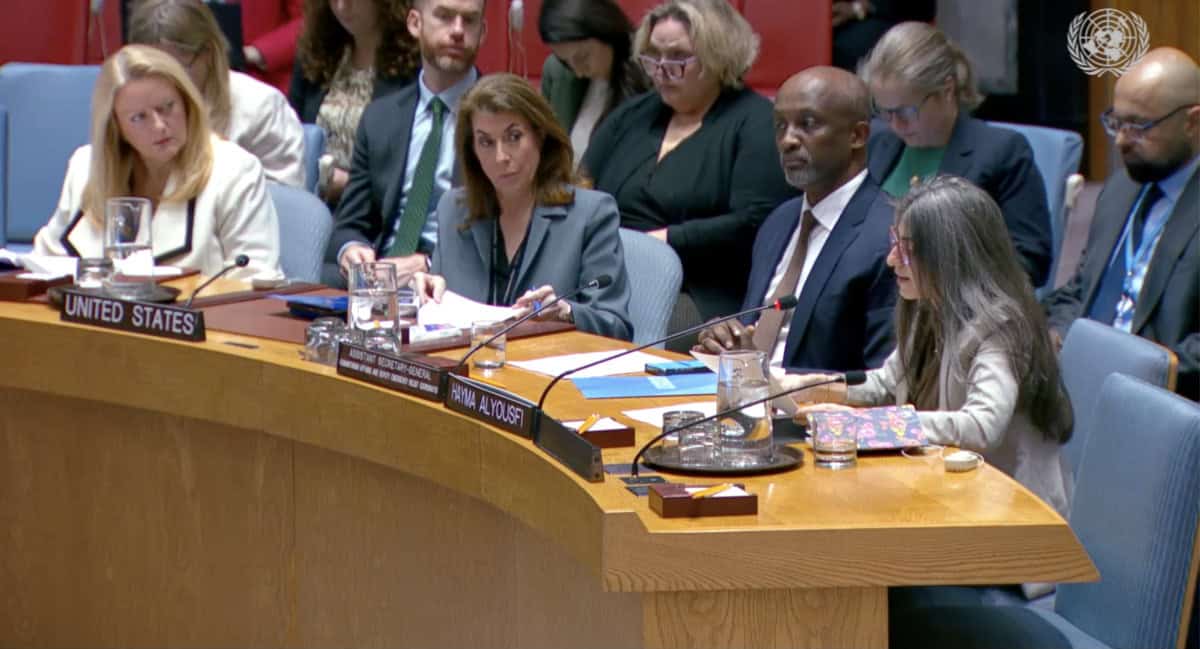
President, Excellencies,
Thank you for the opportunity to brief you today.
My name is Hayma Alyousfi and I speak to you as a Syrian feminist and human rights defender.
I have spent years working alongside Syrian women activists who insisted on telling stories that others wanted buried. Women who relentlessly demanded justice, defended human rights, challenged patriarchy, and refused to accept that decisions about their lives could be made without them.
Let me begin with a question I have carried with me throughout my work. What does it mean to be free if you are still afraid to speak?
The fall of the Assad regime brought Syrians a historic opportunity after decades of authoritarianism, repression and fear. But the test today is whether Syrians can speak out without fear or retaliation, and whether the institutions being built will protect their rights rather than reproduce old forms of control.
I want to draw the Council’s attention to three interconnected issues: violence against women in public spaces, restrictive media regulations, and the fragile space for independent civil society.
First, Syrian women who speak publicly face online abuse, including sexualized threats, defamation, doxxing and campaigns intended to discredit them.[1] Women from marginalized communities and those challenging dominant political and patriarchal narratives face additional risks.[2]
These attacks are not necessarily spontaneous or isolated. Investigative reports have documented coordinated campaigns involving networks of social media accounts that amplify accusations, circulate misleading narratives, and mobilize hostility against women who exercise their right to speak out — all in an attempt to silence them.[3] In some cases, such activity was traced to closed WhatsApp groups allegedly involving officials in the Ministry of Information, although they denied directing such campaigns.[4]
These attacks occur against the backdrop of women’s severely limited representation in Syria’s transitional institutions, including in parliament[5] and senior decision-making.[6] There is a troubling contradiction when women are presented as evidence of an inclusive transition, while those who challenge authority are attacked.
The consequences extend beyond the screen. When a journalist self-censors, an activist abandons public engagement, or a human rights defender withdraws, their communities consequently lose voices that would otherwise bring their experiences into public debate. Online abuse can also lead to blackmail, family retaliation and physical violence.[7]
Syrian women need accessible reporting mechanisms, survivor-centered services and accountability for perpetrators.
But we must not have to choose between protection from abuse and the freedom to speak out.
This brings me to the second issue: the legal and regulatory environment for freedom of expression remains a serious concern.
Syria has experienced a significant opening in public expression since December 2024, but this progress remains fragile.[8] During the first half of 2026, Amnesty International documented five cases of journalists and activists detained for online expression under the former regime’s Cybercrime Law No. 20,[9] which contains broadly defined offences that have been used selectively against critics. This law and other inherited defamation, insult and cybercrime provisions continue to be used to criminalize criticism and civic activism, while protection from online abuse and incitement remains inconsistent.[10]
The response to online violence must not become justification for excessive state regulation of digital spaces. Laws addressing women’s protection, harmful content or disinformation can cause further harm when they are vague or enforced selectively. As Syria undertakes constitutional and legislative reforms, it is essential to establish clear safeguards for freedom of expression, media independence and women’s participation in public debate. Such safeguards must be developed with the meaningful involvement of human rights defenders, independent media and women’s rights organizations.
When Syrian journalists cannot rely on the law for protection and may even fear its misuse, this can lead to self-censorship. Any laws to regulate the media and their application must not restrict investigative journalism or access to information, silence criticism of public officials or discourage journalists from calling out violations.[11]
Third, independent civil society is essential for accountability, public trust and democratic governance in Syria. Feminist and women-led organizations must be recognized as independent actors with the right to scrutinize policies and challenge authorities, not simply as implementers of governmental plans or partners to deliver humanitarian or social services. Yet they face bureaucratic obstacles in registration and project approvals, limited access to decision-making, funding constraints and attempts to undermine their legitimacy.[12]
Since December 2024, hundreds of civil society organizations have registered in Syria,[13] but registration alone does not guarantee freedom to operate. Restrictions on freedom of association and public organizing, unclear administrative requirements and the risk of retaliation can discourage organizations from carrying out precisely the work that a credible transition requires.[14] A free and open civil society must be able to organize collectively, establish independent unions and professional syndicates, hold public discussions, express criticism and participate in decisions that affect their lives.
Excellencies, these concerns lead me to the following recommendations:
First, to the Syrian transitional authorities:
- Make women’s participation a priority. I urge you to guarantee women’s full, equal, meaningful and safe participation in political institutions and transition processes, including constitutional and legislative reform, transitional justice, security sector reform and local governance. Representation must translate into influence over decisions, not merely presence in the room.
- Further, I urge you to suspend enforcement of restrictive Assad-era laws on expression and assembly, and ensure that all legislation complies with Syria’s international human rights obligations.[15] Laws addressing issues like online abuse, media freedom[16] and civil society work must be precise, proportionate and applied without discrimination or political interference. Attacks against women must be swiftly investigated, and remedies for technology-facilitated gender-based violence must be accessible and developed in consultation with women’s rights and digital rights experts. Such measures must protect survivors’ privacy and autonomy, and avoid criminalizing those who report abuse.
Second, to the Security Council and broader international community:
Ensure that diplomatic engagement and support for Syria’s recovery strengthen Syrian-led efforts towards equality, accountability and the rule of law. Progress should be assessed against concrete benchmarks, including women’s meaningful participation, the protection of activists and human rights defenders from reprisals, and media and civil society’s ability to operate and organize without interference. These benchmarks should be informed by Syria’s international human rights obligations and developed through meaningful consultation with Syrian civil society. Member States should raise setbacks consistently through diplomatic engagement.
Third, to the UN:
UN entities and the Office of the Special Envoy should maintain consultations with diverse human rights defenders, journalists, feminist organizations and grassroots actors across Syria. Their recommendations must inform political engagement with the transitional authorities. Further, any future UN presence should have dedicated gender expertise, and the capacity to monitor violations by state and non-state actors, including restrictions on expression and association, obstacles to women’s participation and reprisals against human rights defenders.
Finally, to donors:
I urge you to support independent Syrian civil society through sustained, flexible funding, and ensure that reconstruction and institutional assistance advance equality, accountability and the rule of law.
Excellencies,
We have fought for years for freedom, dignity and justice. We have endured loss, but we have not lost hope. Our struggle is now to build a country where freedoms are protected and no one is above accountability. Syria has this opportunity. But it requires a fundamental change in the relationship between the state and its citizens.
Stability built on silence is not peace. And a transition that excludes women cannot deliver the future that Syrians deserve. Thank you.
__________________
Photo: UN Web TV
[1] Syrian Feminist Lobby, “Position Paper on the Situation of Women in Syria and the Requirements for the Transitional Period,” pp. 6-7, 14 August 2026, https://syrianfeministlobby.org/en/2026/08/14/position-paper-on-the-situation-of-women-in-syriaand-the-requirements-for-the-transitional-period/; DW Akademie, “Safer platforms, stronger participation: Mapping gender-based violence online in Syria,” 19 March 2026, https://akademie.dw.com/en/safer-platforms-stronger-participation-mapping-impacts-drivers-and-responses-to-gender-based-violence-online-in-syria/a-76398807.
[2] DW Akademie, “Safer platforms, stronger participation: Mapping gender-based violence online in Syria,” pp. 23-26, 19 March 2026, https://akademie.dw.com/en/safer-platforms-stronger-participation-mapping-impacts-drivers-and-responses-to-gender-based-violence-online-in-syria/a-76398807.
[3] Nardine Al-Rawi and Sami Sabir, “Coordinated digital campaigns targeting dissidents and activists in Syria,” Arab Reporters for Investigative Journalism, 21 October 2026, https://arij.net/investigations/syria-coordinated-campaigns-targeting-activists/; OHCHR, “Statement by the Independent International Commission of Inquiry on the Syrian Arab Republic accompanying its Oral Update to the 63rd Session of the Human Rights Council,” 8 September 2026, https://www.ohchr.org/en/statements-and-speeches/2026/09/statement-independent-international-commission-inquiry-syrian-arab?sub-site=HRC [expressing concern about the impact of hate speech and threats of violence on women’s willingness to participate in public affairs]; Zaina Erhaim, “The Algorithm of Fear: Influencers, Impunity, and the Silencing of Syrian Women,” Arab Reform Initiative, 17 July 2026, https://www.arab-reform.net/publication/the-algorithm-of-fear-influencers-impunity-and-the-silencing-of-syrian-women/.
[4] Nardine Al-Rawi and Sami Sabir, “Coordinated digital campaigns targeting dissidents and activists in Syria,” Arab Reporters for Investigative Journalism, 21 October 2026, https://arij.net/investigations/syria-coordinated-campaigns-targeting-activists/.
[5] Women comprise 22 of 206 members of the People’s Assembly (10.7%), 15 of whom were appointed in July 2026 by the President. Briefing to the UN Security Council by Deputy Special Envoy Claudio Cordone, 21 July 2026, S/PV.10199, https://docs.un.org/S/PV.10199.
[6] For example, only one member of the transitional cabinet is a woman, and all fourteen regional governors are men. UN Women, “Update on Women, Peace and Security in Syria,” p. 2, 30 April 2026, https://knowledge.unwomen.org/sites/default/files/2026-05/IEG-meeting-2026-04-30-Syria-update-en.pdf.
[7] ACAPS, “Technology-Facilitated Gender-Based Violence in Northwest Syria,” pp. 17-18, 3 June 2025, https://www.acaps.org/fileadmin/Data_Product/Main_media/20250603_ACAPS_UNFPA_Syria_TFGBV.pdf.
[8] See Research Center for Alternative Development et. al., “Joint Submission to the Universal Periodic Review of Syria,” ¶29-39, 17 July 2026, https://annd.org/en/publications/details/syria-upr-joint-civil-society-submission; Committee to Protect Journalists, “Joint Submission by the Committee to Protect Journalists and the Syrian Centre for Media and Freedom of Expression for the 54th Session of the Universal Periodic Review Working Group, January-February 2027 – Syrian Arab Republic,” 17 July 2026, https://cpj.org/wp-content/uploads/2026/07/UN-UPR-CPJ-and-SCM-Syrian-Arab-Republic-Stakeholder-Submission.pdf.
[9] Amnesty International, “Syria: Suspend use of Assad-era cybercrime law pending reform,” 24 July 2026, https://www.amnesty.org/en/latest/news/2026/07/syria-suspend-use-of-assad-era-cybercrime-law-pending-reform/.
[10] Amnesty International, “Syria: Ending Impunity, Protecting Rights – Submission to the 54th Session of the UPR Working Group, January-February 2027,” ¶13-15, July 2026, https://www.amnesty.org/en/wp-content/uploads/2026/07/MDE2409242026ENGLISH.pdf;
Human Rights Watch, “Submission to the Universal Periodic Review of the Syrian Arab Republic,” ¶19-25, 16 July 2026, https://www.hrw.org/news/2026/07/16/submission-to-the-universal-periodic-review-of-syrian-arab-republic; Syrian Initiative for Fundamental Rights, “Joint Position Paper on the Directive from the Minister of Social Affairs and Labor,” 22 October 2025, https://thesifr.org/en/papers/social-affairs-directive-2025-10/.
[11] Amir Huquq, Mohammad Deeb Bazzet and Mowaffat al-Khouja, “Syrian Media: Mechanisms Hamper Access to Information as Law Is Drafted in the Shadows,” Enab Baladi, 27 August 2026, https://english.enabbaladi.net/archives/2026/08/syrian-media-mechanisms-hamper-access-to-information-as-law-is-drafted-in-the-shadows/; Enab Baladi, “Journalists Discuss Proposals for New Syrian Media Law,” 22 July 2026, https://english.enabbaladi.net/archives/2026/07/journalists-discuss-proposals-for-new-syrian-media-law/amp/.
[12] Femena, “Syria in Transition: Women Human Rights Defenders, Civic Space, and Gender Justice,” 3 August 2026, https://femena.net/2026/08/03/syria-in-transition-women-human-rights-defenders-civic-space-and-gender-justice/.
[13] Fadel Abdulghany and Kenneth Roth, “Assessing Syria’s Progress Since Assad,” Opinio Juris, 20 February 2026, https://opiniojuris.org/2026/02/20/assessing-syrias-progress-since-assad/ [noting that over 650 NGOs registered in the first half of 2025]; The Syria Report, “Chart: NGOs Registered in Syria Per Governorate (2025),” 6 January 2026, https://syria-report.com/chart-ngos-registered-in-syria-per-government-2025/.
[14] See European Union Agency for Asylum, “Freedom of expression, civic space and criticism of the authorities,” July 2026, https://www.euaa.europa.eu/syria-country-focus/222-freedom-expression-civic-space-and-criticism-authorities; Cathrin Schaer and Omar Albam, “How an Assad-era law is threatening Syrian civil society,” DW, 5 February 2026, https://www.dw.com/en/how-an-assad-era-law-is-threatening-civil-society-groups-in-syria/a-75824075.
[15] See for example Syrian Initiative for Fundamental Rights, “From State Control to Safeguarding Independence: Essential Safeguards for Syria’s New Law on Associations,” 8 September 2026, https://stj-sy.org/wp-content/uploads/2026/09/From-State-Control-to-Safeguarding-Independence-Essential-Safeguards-for-Syrias-New-Law-on-Associations.pdf.
[16] See Syria Today, “Media Prohibitions in Syria: Regulation or a Renewed Threat to Press Freedom?” translation by The Syrian Observer, 30 June 2026, https://syrianobserver.com/syrian-actors/media-prohibitions-in-syria-regulation-or-a-renewed-threat-to-press-freedom.html.