
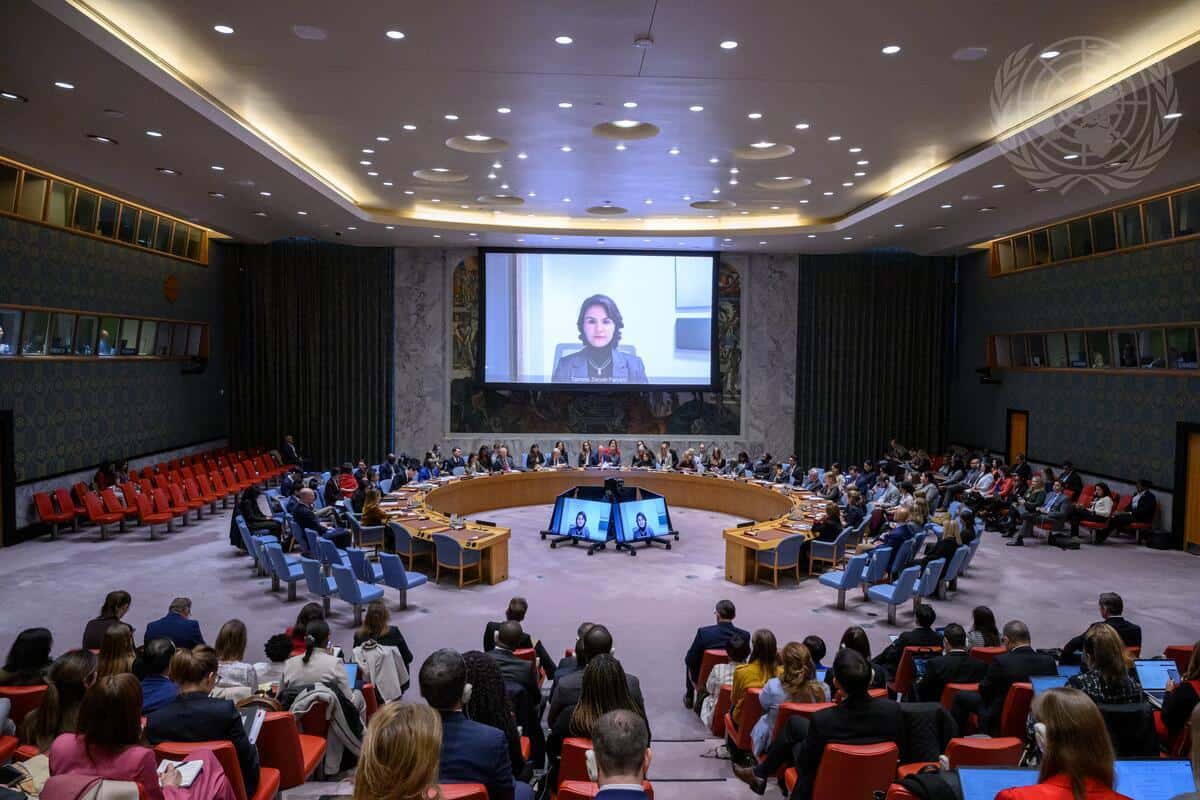
This statement was made by Ms. Tamana Zaryab Paryani, human rights activist, at the United Nations Security Council Open Debate on Women, Peace and Security.
President, Excellencies,
Thank you for the opportunity to brief you today.
In the name of humanity, freedom, justice and equality.
My name is Tamana Zaryab Paryani. Some of you may recognize me. I am the woman in the video from 2022[1] — the one trembling with fear, crying for help from inside a bedroom while Taliban forces surrounded her home in the middle of the night. I am the woman who thought she might not survive that night.
I was with my three sisters when Taliban forces stormed into our home. They came to silence me for my activism for human rights, as they have silenced others. But that night, from my small apartment in Kabul, despite my fear, I chose to document their crimes. That video helped save my life. Had I not had access to the internet, had I not held my phone in my hand, I might not be here today. Others have not been as lucky.
I was imprisoned and tortured by the Taliban. When I was detained, we could hear the screams of prisoners silenced by gunfire. We saw the bodies of dead prisoners left to decay.
These memories will never leave me. They show what the Taliban is willing to do to those who defy them.
My struggle against violence and inequality has come at a great cost. My family has suffered. My friends have suffered. I have suffered. Yet I continue to speak out because remaining silent is not an option.
Especially for women in Afghanistan, speaking out is not easy. It means challenging systems designed to silence you. It means risking your freedom, your safety, and sometimes your life.
Today marks five years and 73 days since women in Afghanistan have lived under a system of gender apartheid. I experienced it personally, including during my imprisonment. Millions of other women and girls in Afghanistan continue to experience it every single day. Afghanistan is the only country on the planet where girls are systematically denied education[2] and where women are excluded from nearly every aspect of public life.[3] Women are banned from universities[4] and most jobs.[5] They cannot move freely and are banned from parks, gyms and countless public spaces.[6] They are denied the basic freedoms that many people around the world take for granted.
We have never stopped resisting the Taliban. We organized months of street protests under the Campaign to Stop Gender Apartheid in Afghanistan.[7] In 2023, we went on hunger strike in Germany, demanding that the world recognize the Taliban’s gender apartheid as an international crime.[8] We were joined by activists around the globe.
And yet, neither the urgency of this crisis nor our activism has moved you. The international community has failed us.
We hear statements. We hear expressions of concern. But the women of Afghanistan need action, not words.
Every day that passes, another generation of women and girls loses opportunities, dreams and futures.
This is not only Afghanistan’s crisis. Violations do not stop at borders. They spread when they are tolerated. They grow when they are ignored. That is why what is happening in Afghanistan should concern every nation represented here today.
If you are a parent, stand up for the future of your daughters. If you are a brother, stand firm beside your sisters. And if none of these roles define you, then stand up for our common humanity. Because none of us can claim ignorance. None of us can say we did not know.
During my imprisonment, I witnessed the true face of misogyny. I saw what happens when violence and discrimination are allowed to become systems of power. And I know this: If the world fails to act in Afghanistan, others will learn they too can get away with such crimes.
Today, as we reflect on the state of women’s rights globally, the situation I have described in Afghanistan tells the story of what happens when every principle that the Women, Peace and Security agenda stands for is ignored: when women are forced out of public life, when their rights are routinely violated, and when there are no mechanisms to hold violators accountable. We see other examples in the Occupied Palestinian Territory,[9] Sudan,[10] Myanmar[11] and too many others, where women pay the price for wars they did not start and decisions in which they had no voice.
Today, I have three messages to the Security Council that can both impact the lives of women in Afghanistan, and move gender equality forward globally:
- Center gender justice and women’s rights throughout this Council’s work, including on Afghanistan. The targeting of women and marginalized groups should be treated as a warning, and a threat to international peace and security. Do not normalize these violations, or actors, like the Taliban, who commit them. An alarming number of countries have handed over embassies to the Taliban[12] or given them diplomatic recognition.[13] Others are seeking the Taliban’s help in deporting people to Afghanistan.[14] So, it bears repeating: Women’s rights must be the number one priority in any engagement with the Taliban. When that does not happen, you are failing us and you are failing all women everywhere.
- Hold violators of women’s rights, like the Taliban, accountable. Codify gender apartheid as a crime against humanity.[15] Support the case at the International Court of Justice for violations of CEDAW.[16] Support efforts to arrest Taliban leaders for gender persecution.[17] These actions could help prevent this type of systematic oppression of women from happening elsewhere.
- Demand women’s participation in all discussions about their own future. Over the years, this Council has heard powerful statements from many women leaders from Afghanistan.[18] Yet, too often, the international community has chosen to listen to the men with guns, rather than the women who are fighting for the rights of their communities. If we truly hope to end cycles of conflict, women’s full participation — in peacemaking, in accountability efforts, in humanitarian delivery — holds the key to a just and equal Afghanistan.
To those of you who believe you have no power to change the situation of women in Afghanistan, I ask you to remember my story. The Taliban have shot at me and my fellow protestors. We have been whipped, gassed and beaten. And we have picked ourselves up and come back the next day to protest the Taliban’s cruel policies.
That is because we know that rights are won through struggle. We know that we are the resistance to repression. Freedom is never granted; it is won. And we will not stop until we win justice and equality for all women.
Thank you.
Photo: UN Photo/Loey Felipe
[1] CBS News, “Afghan women’s rights activist tells her story,” 16 August 2022, https://www.cbsnews.com/video/afghan-womens-rights-activist-tells-her-story-one-year-after-taliban-took-over-kabul/.
[2] Report of the Special Rapporteur on the situation of human rights in Afghanistan, Richard Bennett, ¶49-53, 29 July 2026, A/HRC/63/22, https://www.ohchr.org/en/documents/country-reports/ahrc6322-situation-human-rights-afghanistan-report-special-rapporteur; Rawadari, “Afghanistan Human Rights Situation Report 2025,” pp. 59-63, 25 March 2026, https://rawadari.org/reports/afghanistan-human-rights-situation-report-2025/; Committee on the Elimination of Discrimination against Women, “Concluding observations on the fourth periodic report of Afghanistan,” ¶30-31, 10 July 2025, CEDAW/C/AFG/CO/4, https://docs.un.org/en/CEDAW/C/AFG/CO/4.
[3] UN Women, “Five Years On: Afghan Women’s Futures at a Crossroads,” August 2026, https://asiapacific.unwomen.org/en/digital-library/publications/2026/08/five-years-on; Committee on the Elimination of Discrimination against Women, “Concluding observations on the fourth periodic report of Afghanistan,” ¶24-25, 10 July 2025, CEDAW/C/AFG/CO/4, https://docs.un.org/en/CEDAW/C/AFG/CO/4.
[4] Women have been banned from attending universities in Afghanistan since December 2022. Hikmat Noori, “Taliban ban Afghan women from university education,” The Guardian, 20 December 2022, https://www.theguardian.com/world/2022/dec/20/taliban-ban-afghan-women-university-education.
[5] International Labour Organization, “Afghanistan’s labour market five years after the Taliban takeover: Trends, challenges and emerging risks,” 18 August 2026, https://www.ilo.org/publications/afghanistans-labour-market-five-years-after-taliban-takeover-trends; Report of the Special Rapporteur on the situation of human rights in Afghanistan, Richard Bennett, ¶13-14, 8 October 2025, A/80/432, https://docs.un.org/en/A/80/432.
[6] UNAMA, “Update on the human rights situation in Afghanistan: July-September 2026,” p. 3, 15 October 2026, https://unama.unmissions.org/sites/default/files/2026-10/english_-_update_on_human_rights_in_afghanistan_-_july-september_2026_.pdf; UN Women, “Five Years On: Afghan Women’s Futures at a Crossroads,” p. 6, August 2026, https://asiapacific.unwomen.org/en/digital-library/publications/2026/08/five-years-on [noting that over half of Afghan women leave their homes twice a month or less]; UNAMA, “Update on Human Rights in Afghanistan – April-June 2026,” pp. 2-3, https://unama.unmissions.org/en/document-library/update-on-human-rights-in-afghanistan-april-june-2026; Rawadari, “Afghanistan Human Rights Situation Report 2025,” pp. 69-71, 25 March 2026, https://rawadari.org/reports/afghanistan-human-rights-situation-report-2025/; Special Rapporteur on the situation of human rights in Afghanistan, “Study on the so-called law on the promotion of virtue and the prevention of vice,” ¶49-54, 12 March 2025, A/HRC/58/74, https://www.ohchr.org/en/documents/country-reports/ahrc5874-study-so-called-law-promotion-virtue-and-prevention-vice-advance.
[7] See Afghanistan International, “Afghan Women Activists Resume Protest To Demand Recognition of Gender Apartheid,” 30 September 2023, https://www.afintl.com/en/202309309446.
[8] Radio Free Europe/Radio Liberty, “Afghan Women On Hunger Strike in Germany To Protest ‘Gender Apartheid’,” 4 September 2023, https://www.rferl.org/a/afghanistan-women-gender-apartheid/32578004.html.
[9] See UN Women, “Advocacy brief: The cost of war in Gaza on women and girls,” April 2026, https://www.unwomen.org/en/digital-library/publications/2026/04/advocacy-brief-the-cost-of-war-in-gaza-on-women-and-girls; OHCHR, “Sexual and gender-based violence against Palestinians driving displacement, warn UN experts,” 30 April 2026, https://www.ohchr.org/en/press-releases/2026/04/sexual-and-gender-based-violence-against-palestinians-driving-displacement; Statement by Ms. Noura Erakat at the UN Security Council Open Debate on Women, Peace and Security, 6 October 2025, https://www.womenpeacesecurity.org/resource/statement-noura-erakat-security-council-open-debate-women-peace-security/.
[10] See UN Security Council Briefing on Sudan by Dr. Eva Khair, 24 August 2026, https://www.womenpeacesecurity.org/resource/un-security-council-briefing-sudan-eva-khair/; UN Women, “Gender alert: Three years of war: Sudanese women on the frontlines of humanitarian and local peacebuilding efforts,” April 2026, https://www.unwomen.org/en/digital-library/publications/2026/04/gender-alert-three-years-of-war-sudanese-women-on-the-frontlines-of-humanitarian-and-local-peacebuilding-efforts; UN Security Council Briefing on Sudan by Hala Alkarib, 19 February 2026, https://www.womenpeacesecurity.org/resource/un-security-council-briefing-sudan-hala-alkarib/.
[11] See UN Women, “Update on Women, Peace and Security in Myanmar,” 30 July 2026, https://knowledge.unwomen.org/sites/default/files/2026-07/IEG-meeting-2026-07-30-Myanmar-update-en.pdf; Statement by Ms. Wai Wai Nu at the UN Security Council Open Debate on Women, Peace and Security, 24 October 2024, https://www.womenpeacesecurity.org/resource/statement-wai-wai-nu-security-council-open-debate-women-peace-security/.
[12] See Afghanistan International, “Afghan Embassy in Kuwait Handed Over To Taliban, Says Sources,” 4 June 2026, https://www.afintl.com/en/202606040969; Nazanin Mohseni, “Afghanistan Embassy in India Handed Over to Taliban; Resistance Council Calls It ‘Contrary to Ground Realities’,” 18 January 2026, https://kabulnow.com/2026/01/afghanistan-embassy-in-india-handed-over-to-taliban-resistance-council-calls-it-contrary-to-ground-realities/; Afghanistan International, “Norway Accepts Taliban Diplomat, Consular Services To Resume At Afghan Embassy in Oslo,” 22 March 2025, https://www.afintl.com/en/202503228768.
[13] Ministry of Foreign Affairs of the Russian Federation, “Press release on Ambassador of the Islamic Emirate of Afghanistan to the Russian Federation Gul Hassan Hassan presenting copies of his credentials,” 3 July 2025, https://mid.ru/en/foreign_policy/news/2033886/.
[14] See Elian Peltier and Jim Tankersley, “The Taliban Are Using Europe’s Fear of Migrants to Their Advantage,” The New York Times, 12 October 2026, https://www.nytimes.com/2026/10/12/world/asia/europe-taliban-deportations-migrants.html.
[15] OHCHR, “High Commissioner Türk: Afghanistan must end persecution of women and girls,” 26 February 2026, https://www.ohchr.org/en/statements-and-speeches/2026/02/high-commissioner-turk-afghanistan-must-end-persecution-women-and.
[16] “Joint Civil Society Statement: Two Years of the ICJ-CEDAW Afghanistan Initiative – Call for Action and Transparency,” 25 September 2026, https://www.globalr2p.org/publications/joint-civil-society-statement-two-years-of-the-icj-cedaw-afghanistan-initiative-call-for-action-and-transparency/.
[17] OHCHR, “Afghanistan: UN experts warn against normalisation of Taliban rule,” 13 August 2026, https://www.ohchr.org/en/press-releases/2026/08/afghanistan-un-experts-warn-against-normalisation-taliban-rule [reiterating that the Taliban’s intentional and targeted gender-based deprivation of fundamental rights amounts to the crime against humanity of persecution on gender grounds]; Committee on the Elimination of Discrimination against Women, “Concluding observations on the fourth periodic report of Afghanistan,” ¶11-14, 10 July 2025, CEDAW/C/AFG/CO/4, https://docs.un.org/en/CEDAW/C/AFG/CO/4; Human Rights Watch, “Afghanistan: Taliban’s Gender Crimes Against Humanity,” 8 September 2023, https://www.hrw.org/sites/default/files/media_2023/09/Gender%20Persecution%20final_060923.pdf.
[18] See, for instance, UN Security Council Briefings by: Metra Mehran, 8 June 2026, https://www.womenpeacesecurity.org/resource/un-security-council-briefing-afghanistan-metra-mehran/; Negina Yari, 10 December 2025, https://www.womenpeacesecurity.org/resource/un-security-council-briefing-afghanistan-negina-yari/; Azadah Raz Mohammad, 10 March 2025, https://www.womenpeacesecurity.org/resource/un-security-council-briefing-afghanistan-azadah-raz-mohammad/; Shaharzad Akbar, 20 December 2023, https://www.womenpeacesecurity.org/resource/un-security-council-briefing-afghanistan-shaharzad-akbar/; Zubaida Akbar, 8 March 2023, https://www.womenpeacesecurity.org/resource/un-security-council-briefing-afghanistan-zubaida-akbar/; Zahra Nader, 20 October 2022, https://www.womenpeacesecurity.org/resource/statement-zahra-nader-security-council-open-debate-women-peace-security/; Mariam Safi, 2 March 2022, https://www.womenpeacesecurity.org/resource/un-security-council-briefing-on-afghanistan-by-mariam-safi/.